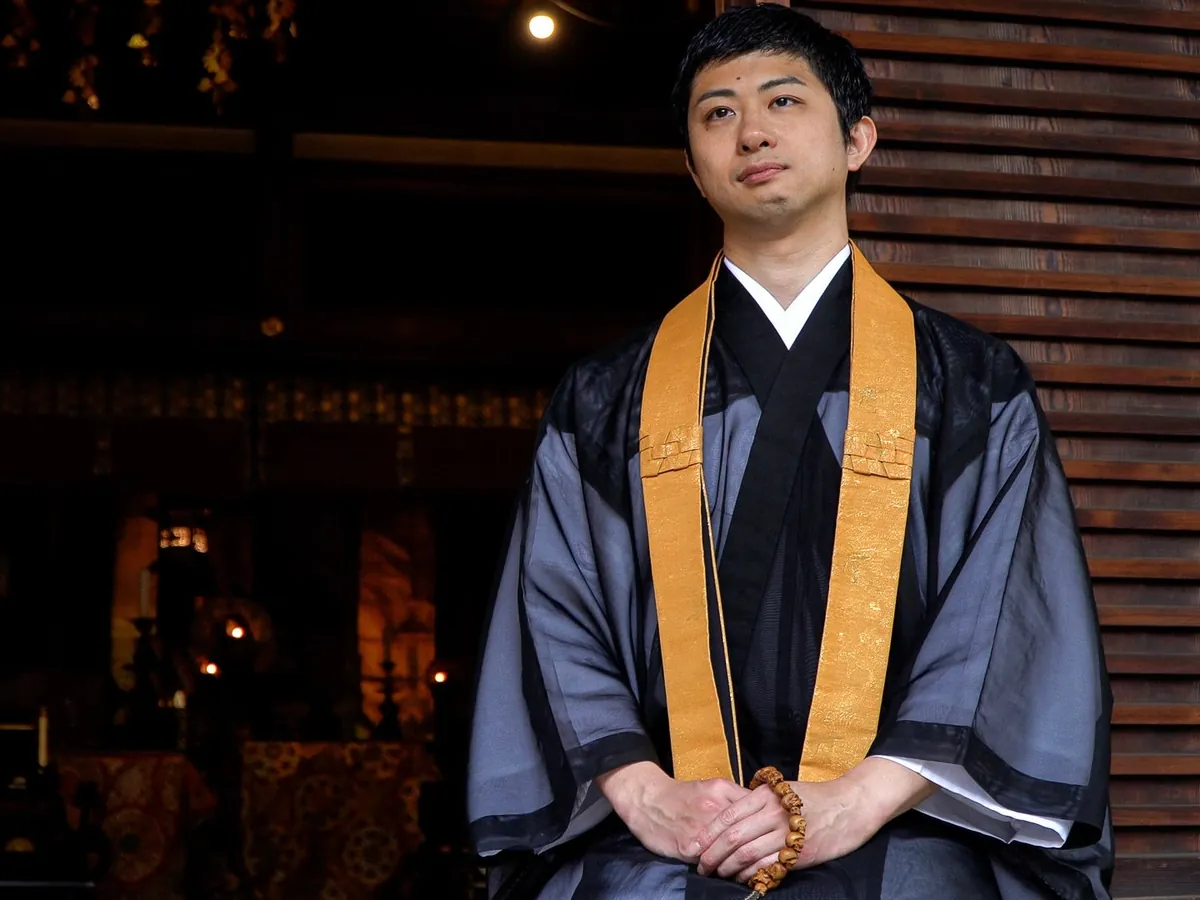
A wagesa (輪袈裟) is a small, simplified kesa worn around the neck as an expression of Buddhist faith. It is a widely used small kesa in Japan. Forms, crests and the cord differ by school and temple, so confirm what yours expects before you order. We also make a folded wagesa that can be washed in a home washing machine.
What is a wagesa?
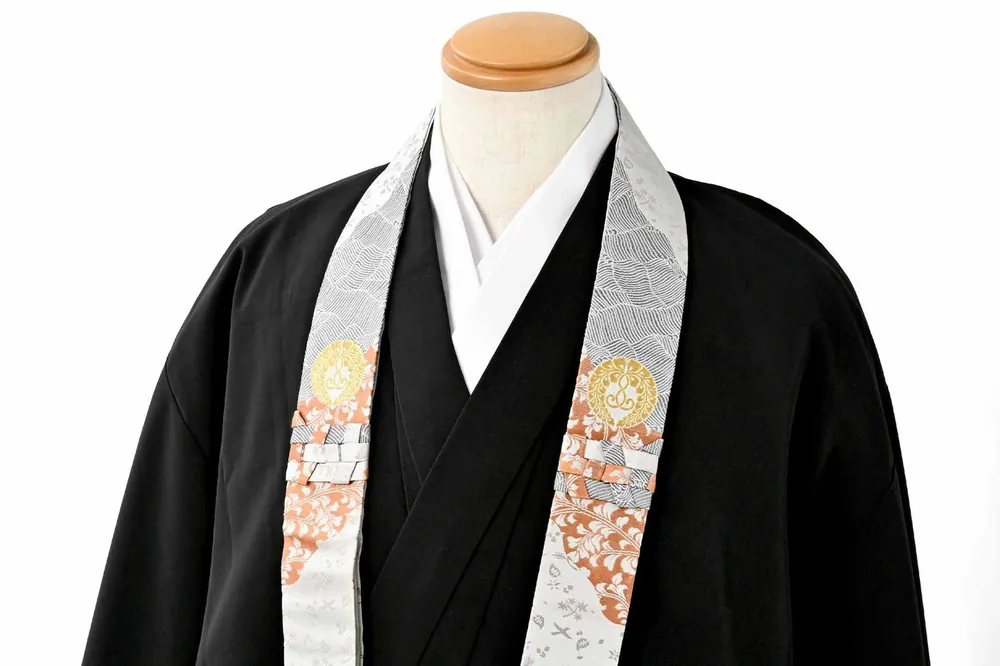
“Wagesa” (輪袈裟) means “ring kesa”. It is a compact kesa that is worn around the neck and hangs down the chest, instead of being draped over the shoulder like a full-size kesa. Our page on small kesa places it among the other neck-worn items; this guide goes deeper on the wagesa itself.
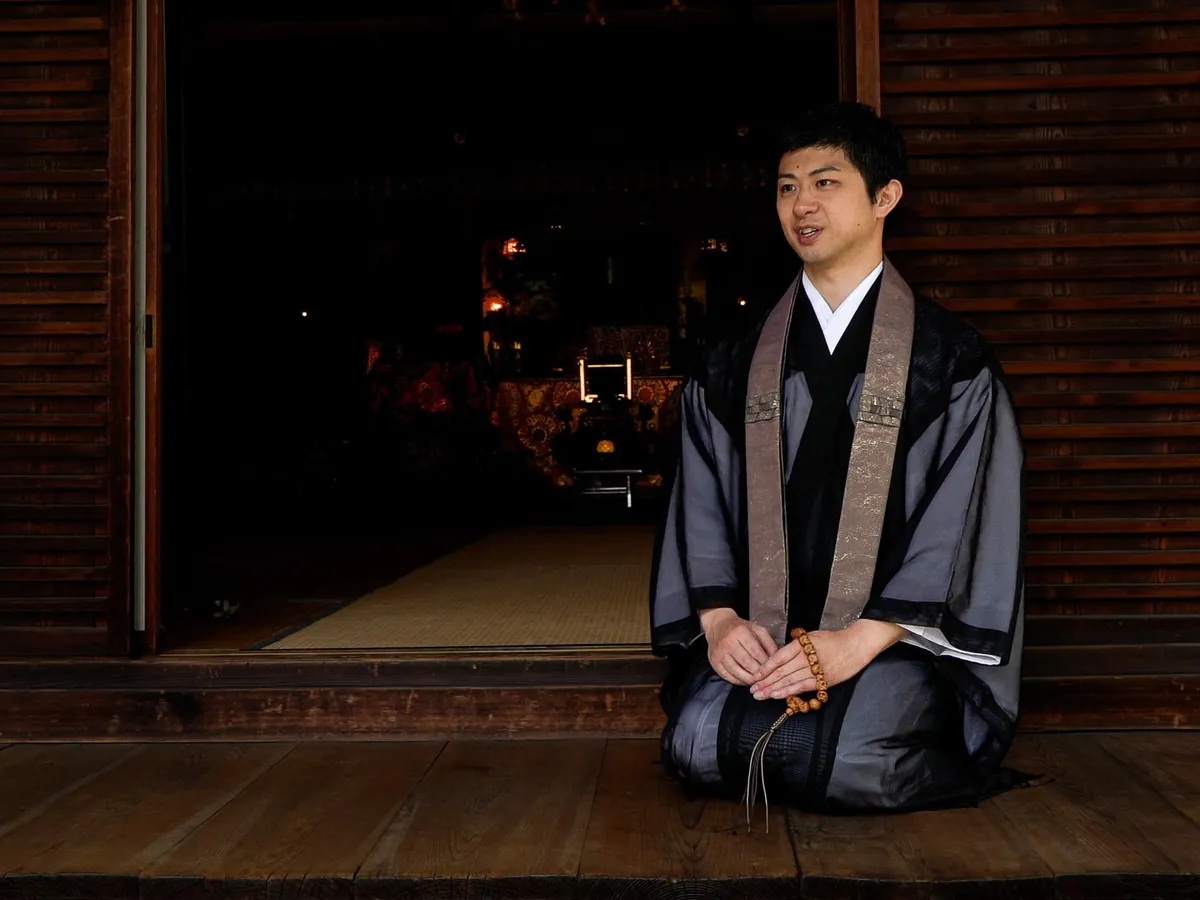
A wagesa is not a substitute for the full kesa on every occasion, and the rules about who may wear one, and at what services, differ by school and temple. What it keeps is the meaning: a kesa is a sign that the wearer is Buddhist, and the wagesa lets lay followers and clergy carry that sign in a form that is easy to wear.
Where does the wagesa come from?
Our Japanese article on this subject, citing Izutsu Gafū’s Kesa-shi (history of the kesa), presents one account of these forms; what follows is a summary of that account, not a complete history of every school’s practice. It describes the simplification of the kesa from the Edo period (1603–1868), including a nine-strip kesa folded for use in Tendai and Shingon, followed by a five-strip kesa folded and hung around the neck. In Shingon it is said to have been simplified further, into a narrow ring made from gold brocade or similar cloth hung around the neck.
According to the same article, lay people wearing a wagesa are mostly seen in schools such as Tendai and Shingon, while for lay members of Jōdo Shinshū Hongwanji-ha the corresponding neck-worn item is the shikishō; in Shinshū Ōtani-ha the term ryaku-kataginu is used. Which form your school uses is something to confirm with your teacher or temple.
What forms does a wagesa take?
People often say “wagesa” for several related items, and in common use the names overlap (some sources treat the tatami-gesa as a kind of wagesa). The table shows how we list the forms we make. Names and who uses what vary by school and temple, so treat it as a map and not as a rulebook.
| Form | What it looks like |
|---|---|
| 輪袈裟 Wagesa | A ring of cloth hung from the neck, often with crests (mon) embroidered on it. The number and placement of crests depend on the school. |
| 畳袈裟 Tatami-gesa | A kesa made to fold up in a concertina (accordion) pattern, as a compact form of the kesa. |
| 折五条 Ori-gojō | A five-strip kesa folded compactly and worn around the neck, finished with a cord of a chosen colour. |
| 略畳袈裟 Ryaku-tatami-gesa | A simplified tatami-gesa. Our washable wagesa (below) is made in this form. |
The same design is often offered in more than one form. On one of our designs, for example, the listing offers a ring wagesa for Shinshū Ōtani-ha, a tatami-gesa for Jōdo Shinshū, an ori-gojō for Jōdo and Shingon, and a seven-crest wagesa for Tendai. That is how we list it, not a rule we ask you to accept: please tell us your school and temple so that we can confirm the right form and crest count before you order.
How do I choose a wagesa?
- School and temple first. Form, crests and colour rules come before taste. Ask your teacher if you are unsure.
- Crests. Many wagesa carry crests. Tell us whether you want none, the temple’s crest or your family’s, and the number your school uses.
- Colour against your robe. A wagesa sits on the chest in front of your robe, so its colour is what people see. Neutral greys and blacks go with most robes; brighter yellows, greens and oranges stand out.
- Season and fabric. Silk brocade is the traditional choice. Summer fabrics such as ro gauze may suit warm weather; weight and feel depend on the particular cloth and construction.
- Budget. Prices follow the fabric and the weaving, as the table below shows.
What fabrics and prices should I expect?
A wagesa is priced by its cloth and by how it is made. These are examples from our online shop, listed from the lowest price for each design; most have options for the form and crests, which change the price. Prices are as of 26 October 2026; please check the product page for the current price, colours and what is in stock.
| Design | Cloth | From (JPY) |
|---|---|---|
| Ichimatsu (checkerboard) | Pastel checkerboard in eight colours; forms for several schools | ¥23,800 |
| Shinran-sama | Gold ground with an embroidered portrait | ¥34,800 |
| Sange (scattered petals) | Scattered-petal design on a pale metallic grey | ¥34,800 |
| Summer gauze “Palm tree” | Summer ro gauze in a choice of colours; availability and price vary by option | ¥32,800 |
| Tatsumura Kōhō “Momiji” (maple) | Brocade by Tatsumura Kōhō (龍村光峯), a weaver separate from Tatsumura Art Textile | ¥51,800 |
| Hand-woven “Tenpyō kikkō” | Hand-woven tortoise-shell pattern | ¥54,800 |
| Washable wagesa | Gauze over gold brocade, four colours | ¥27,800 |
Prices are in Japanese yen, as of 26 October 2026, and may change. Shipping outside Japan and import duties are not included. Many designs are made to order and some are sold out at any given time, so please confirm availability before ordering.
What size is a wagesa?
A wagesa is made to a standard size, and some designs also come in a slightly wider cut (chū-hirohaba, “medium-wide”). If you need a different length or width, or if you are very tall or very small, tell us your height and send a photograph of the wagesa you wear now with its length measured; we will confirm what is possible. Our narrow neck-worn strips (shikishō and hangesa) come, for example in our cherry-blossom design, in child, adult and wide widths of about 4, 5 and 6 cm.
Is there a wagesa I can wash at home?
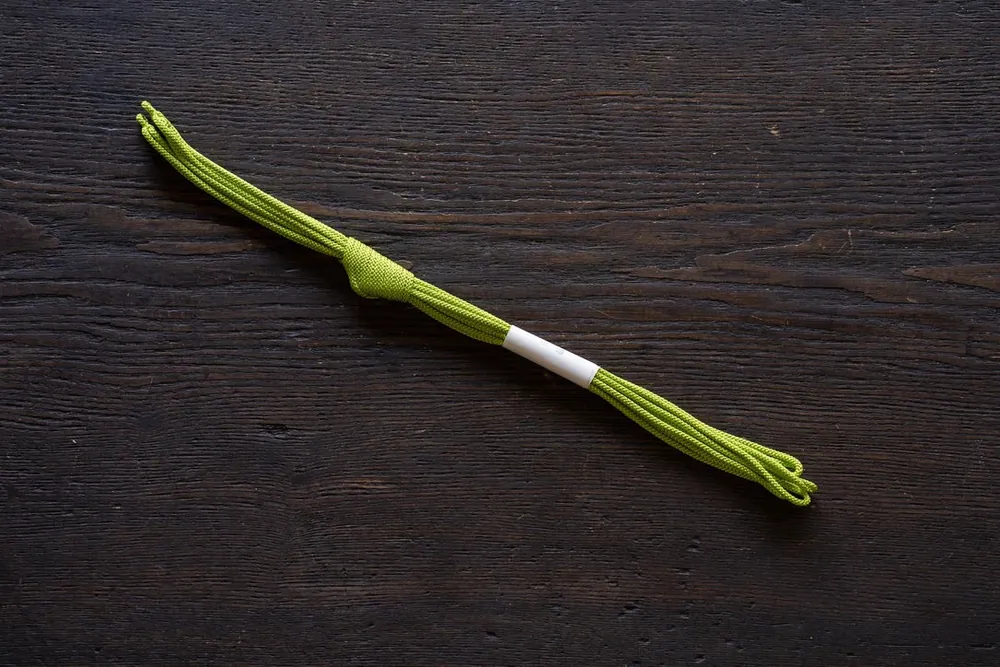
Yes. A wagesa sits against the neck and picks up sweat, especially in summer. Silk wagesa should not be washed at home, which is why we developed a washable one. It is a folded ryaku-tatami-gesa made of a thin gauze cloth (紗, sha) laid over a gold brocade, with a three-dimensional knot in the cord. It comes in four colours: Ukon (bright turmeric yellow), Uraha (soft green), Saganezu (grey) and Binrōji-guro (deep black), with or without two crests (¥27,800 and ¥31,800 as of 26 October 2026).
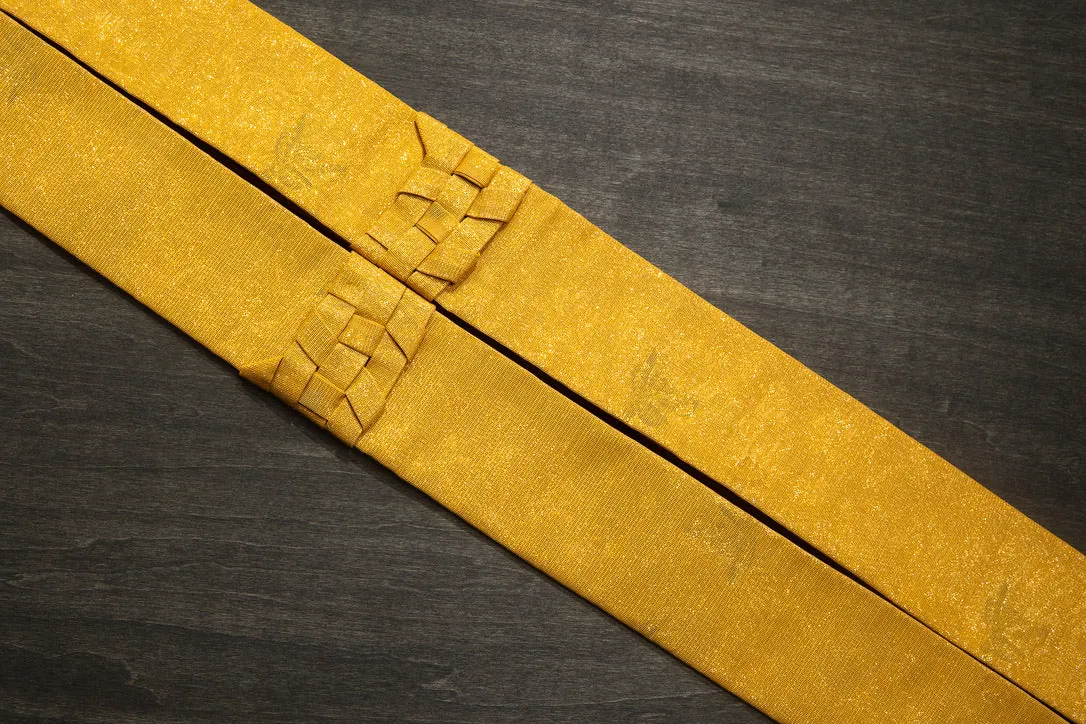
Our care instructions for this wagesa only, and not for any other kesa:
- Put one wagesa at a time in the designated washing net made for it, and wash it separately from other laundry. The net is ¥2,000 when bought on its own, or ¥1,200 with an eligible kesa purchase; please check the product page for the option that applies.
- Use a weak water flow and a gentle spin.
- No bleach and no tumble dryer.
- Reshape it and dry it in the shade, somewhere with good airflow. It dries quickly, but wait until it is completely dry before you wear it.
Other silk, brocade and embroidered kesa should not be washed or spot-cleaned at home; please send us photographs and ask before you try anything. If you are unsure about a wagesa you already own, ask us before washing it.
How do I look after a silk wagesa?
Dirt, sweat and candle wax do most of the damage. Do not rub, scrape or pull at a stain, snagged thread or wax, because it can make the damage worse; keep the item as it is and tell us when and how it happened. Check it before putting it away for a long period, since sweat left in the cloth can show up later as stains or colour change. We also repair and clean kesa made by other shops; send photographs by LINE or email first.
Tell us your school and we will suggest a wagesa
Write to us with your school and temple, the occasions you will wear it, the colour of your robe and your country. We aim to reply in English with the form, the crest count, the price in yen and the lead time.
Browse the shop: wagesa, tatami-gesa and ori-gojō
Frequently asked questions
What is a wagesa?
A wagesa is a small, ring-shaped kesa worn around the neck as a sign of being Buddhist. Forms, crests and the cord vary by school and temple.
What is the difference between a wagesa and a full kesa?
A full-size kesa is worn over the shoulder; its construction varies by type. A wagesa is a compact neck-worn form. Your school and temple determine which is appropriate for a particular service.
Can a wagesa be washed in a washing machine?
Our washable wagesa can, one at a time in its designated washing net with a weak water flow, no bleach and no dryer. Other silk, brocade or embroidered wagesa should not be washed at home; please ask us first.
How much does a wagesa cost?
The examples in this guide start at ¥23,800. The final price depends on the design, form and crests; please check the selected product options on the product page for the current price (as of 26 October 2026, and prices can change).
Can you make a wagesa for my school?
Many designs are made for several schools, with a choice of form, crest count and cord. Tell us your school and temple and we will confirm what can be made.
Keep reading

Written by Kengo Kawakatsu (“Naoshichi”), fourth-generation owner of Naoshichi Houiten, a Kyoto maker of kesa and Buddhist robes since 1920.