In Buddhist accounts the kesa began in India as a robe of discarded rags, changed in China as climate and culture altered how it was worn, and arrived in Japan with Buddhism in the sixth century. Over the next thousand years it became ornamented, was linked in some periods with rank, divided into forms used by different schools and was joined by the small kesa used by followers today.
What was the kesa in India?
In the traditional account, a monk’s robe in the time of the Buddha was a practical thing, made from cloth that had been discarded and sewn together, in keeping with a life of few possessions; see what is a kesa. Monks had a set of three robes (三衣). The colours were deliberately plain.
How did the kesa change in China?
As Buddhism moved along the Silk Road into China, the way the robe was worn and what it meant started to shift. One cause was climate: a thin Indian wrapper does not suit a cold northern winter. People also added their own layers of clothing, and the robes worn beneath developed into what Japanese now call houi (see kesa vs. houi). Over time the kesa itself came to be treated as a symbol of Buddhism.
Scholars have noted how the robe was drawn in the Silk Road cave murals of Bezeklik: Indian monks are painted in robes whose strips are hard to count, while Chinese monks wear robes in which the number of strips is clearly shown. The historian Izutsu Masakaze, in his book Kesa-shi (“History of the Kesa”), suggests from this that the Chinese turned the number of strips into a deliberate design, in line with the idea of the “field of merit”. This is one scholar’s interpretation.
How did the kesa reach Japan?
Buddhism was introduced to Japan in the sixth century. As Buddhism became part of the state, the robes of the clergy picked up another role and started to show rank and authority. Robes that the monks Saichō and Kūkai are traditionally said to have brought back from China in the early ninth century were strongly designed and clearly meant to be solemn, which shows that ornament had arrived. A Tang-dynasty seven-panel robe preserved at Enryakuji and said to have been brought by Saichō is now a National Treasure.
The Kamakura period saw the spread of Zen. Robes of the Zen schools, including the jikitotsu (a long robe made by joining an upper garment to a lower, skirt-like section, traditionally associated with Baizhang Huaihai) and the small rakusu, are associated with it. Rakusu are compact kesa used in Zen traditions, and accounts of their origin and development vary. Meanwhile the seven-strip kesa came to be described as the muted nyohōe and the ornamented shōgon-e; see the shichijō kesa.
When did the kesa signal rank?
It became most visible in the Edo period (1603–1868), when permission to wear particular robes, such as purple ones, was linked to religious status and imperial authority. Today the rules differ by school, and the houi, rather than the kesa, often tells you rank and office.
What is the kesa today?
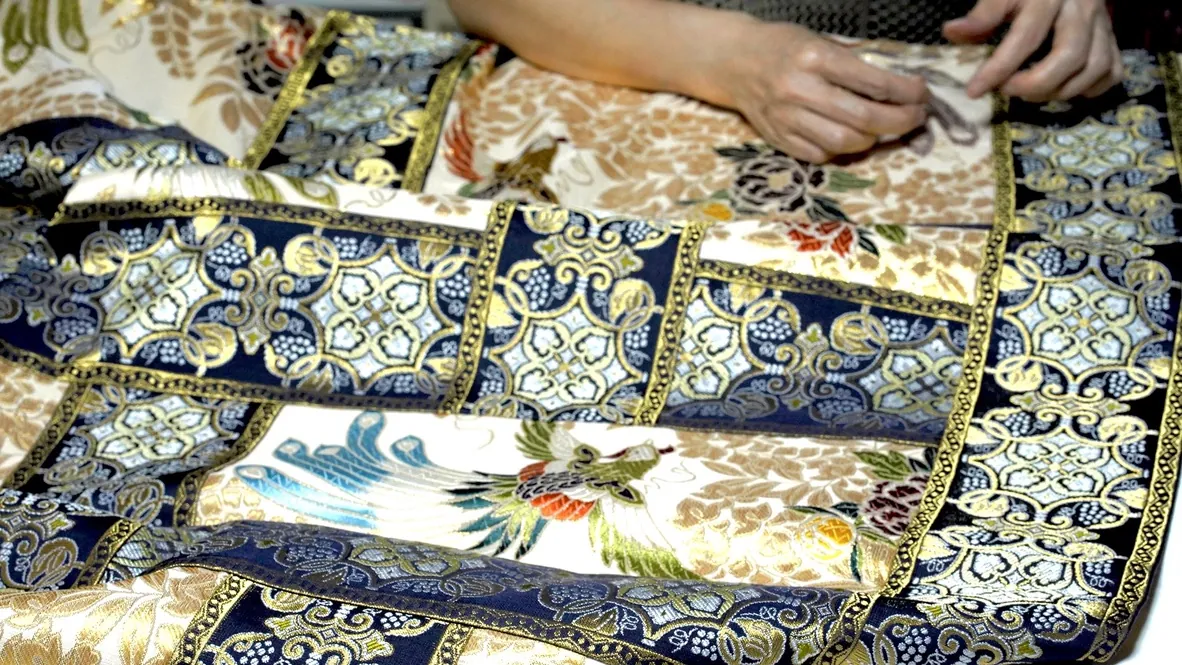
The traditional style of wearing the kesa from the left shoulder can still be recognised today. Kesa are now made of woven silk brocade, sometimes with real gold thread, and range from large ceremonial robes to small pieces worn around the neck. The small kesa for lay followers (the wagesa, for example) show the meaning of the kesa as a sign of the Buddhist: see small kesa.
Our family has worked with kesa for over a century.
Naoshichi Houiten was founded in Kyoto in 1920 and is now in its fourth generation.
Frequently asked questions
When did the kesa arrive in Japan?
With Buddhism, in the sixth century. Robes continued to change in Japan, with notable additions traditionally associated with the early ninth century and the Kamakura period.
Why are Japanese kesa so decorated?
As Buddhism became linked with the state and robes began to show rank, ornament was added, including gold-worked textiles imported from China.
Does the colour of a kesa show rank?
In some periods, yes: permission to wear particular robes such as purple ones was linked to status and imperial authority. Today it varies by school, and the houi often shows rank more than the kesa.
Keep reading

Written by Kengo Kawakatsu (“Naoshichi”), fourth-generation owner of Naoshichi Houiten, a Kyoto maker of kesa and Buddhist robes since 1920.