In short
A short reference to the Japanese words used for Buddhist robes. Each term is given in romaji and in Japanese characters so you can search and compare, with a one-line meaning.
- Kesa (kasaya) 袈裟
- The robe of a Buddhist monk or priest, traditionally a patchwork worn over the left shoulder. From Sanskrit kāṣāya.
- Houi (koromo) 法衣
- A broad word for Buddhist vestments, which can include the kesa. In this shop’s descriptions it usually means the robes worn beneath the kesa. See kesa vs. houi.
- Sanne 三衣
- The three robes of a monk: five-strip, seven-strip and nine-strip or larger.
- Andae (gojō kesa) 安陀会
- The five-strip kesa, Sanskrit antarvāsa. In early accounts, the basic lower robe for daily work and rest.
- Uttarasō (shichijō kesa) 鬱多羅僧
- The seven-strip kesa, Sanskrit uttarāsaṅga. Associated with worship, meals and lectures. See the shichijō kesa.
- Sōgyari (daie) 僧伽梨
- The large kesa of nine to twenty-five panels, Sanskrit saṃghāṭī. A formal ceremonial robe.
- Funzō-e 糞掃衣
- “Rag robe” or “dust-heap robe”: the earliest kesa, sewn from discarded cloth.
- Fukuden-e 福田衣
- “Field of merit robe”: a name for the kesa, whose pattern is likened to rice paddies.
- Ejiki 壊色
- “Broken colour”: a subdued or altered colour, used instead of the five prescribed pure colours (blue or green, yellow, red, white, black). Also read eshiki.
- Nyohō-e 如法衣
- In Jōdo-shū terminology, a seven-strip kesa in muted colour, regarded as close to the robe of the Buddha’s time.
- Shōgon-e 荘厳衣
- In Jōdo-shū terminology, an ornamented seven-strip kesa. Names and rules of use vary across traditions.
- Dainaka 台中
- The rectangular fabric panels of a seven-strip kesa, framed by the en (縁).
- En 縁
- The border cloth running between and around the dainaka; the narrow cloth around the edge of a kesa.
- Yō 葉
- The ridge between the fields of a kesa.
- Jō 条
- A vertical strip of fields. The “five” in five-strip kesa.
- Kō 甲
- An individual field (rectangle) of a kesa.
- Kakujō 角牒
- The small square patches at the four corners of a kesa.
- Kōchū 鉤紐
- The hook and cord that hold the kesa in place.
- Hendan-uken 偏袒右肩
- The traditional style of wearing a kesa from the left shoulder, leaving the right shoulder uncovered. In modern Japan the kesa is usually worn over other robes.
- Tsūken 通肩
- Wearing the kesa so that both shoulders are covered.
- Wagesa 輪袈裟
- A ring-shaped, simplified kesa worn around the neck. See the wagesa guide and small kesa.
- Shikishō 式章
- A narrow neck-worn strip used by Jōdo Shinshū Hongwanji-ha lay members. See shikishō, hangesa and ryaku-kataginu.
- Hangesa 半袈裟
- A narrow neck-worn kesa. Our shop can make hangesa to the specification of schools including Jōdo, Shingon and Sōtō.
- Rakusu 絡子
- A small kesa hung from the neck, used in Zen traditions.
- Ori-gojō 折五条
- A five-strip kesa folded compactly and worn around the neck.
- Tatami-gesa 畳袈裟
- A kesa made to fold up in an accordion pattern.
- Sumi-gesa 墨袈裟
- A black kesa. The form required for ordination (tokudo) or training depends on the school.
- Kaeshibari (kyakushi) 却刺
- Traditional stitching methods used in kesa making; in some hand-sewn examples only small stitches are visible on the front.
- Kassetsu-e 割截衣
- A kesa in which cut sections are joined by sewing; each field is a separately cut piece of cloth.
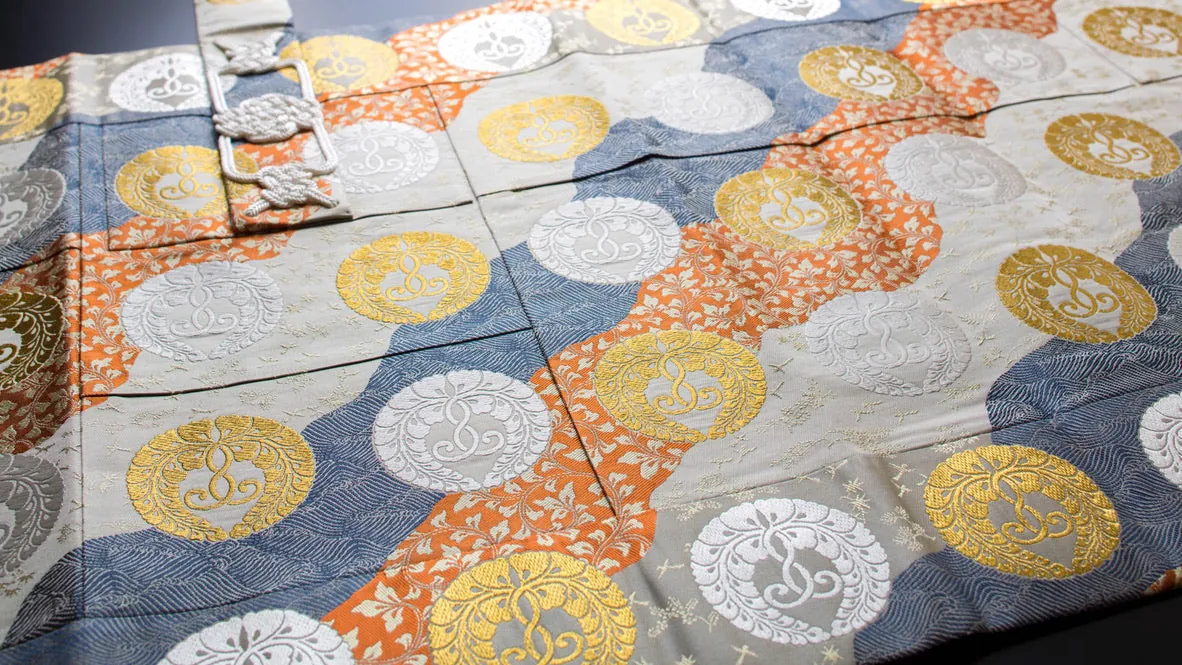
- Kinran 金襴
- Gold brocade: silk woven with gold threads, used for kesa and robes.
- Jikitotsu 直綴
- A long Buddhist robe made by joining an upper garment to a lower, skirt-like section. Its development is traditionally associated with Baizhang Huaihai.
- Hakue 白衣
- The white under-garment worn beneath a priest’s robe.
- Tokudo 得度
- Ordination: the ceremony by which a person becomes a Buddhist priest.
- Nenju 念珠
- Buddhist prayer beads, carried with a kesa or shikishō.
Keep reading

Written by Kengo Kawakatsu (“Naoshichi”), fourth-generation owner of Naoshichi Houiten, a Kyoto maker of kesa and Buddhist robes since 1920.