Alongside full-size kesa there is a family of compact kesa worn around the neck: the wagesa (ring-shaped), shikishō and hangesa (narrow strips), the rakusu of Zen traditions and the folded ori-gojō. Designs and rules of use vary by school and temple, so please confirm what your tradition expects before you order.
Why are there small kesa?
A full kesa is large, precious and hard to wear all day. Over the centuries Japanese Buddhism developed compact versions that keep the meaning of the kesa as a sign that the wearer is Buddhist. Some are worn by clergy, some by lay followers, and some by pilgrims, depending on the school.
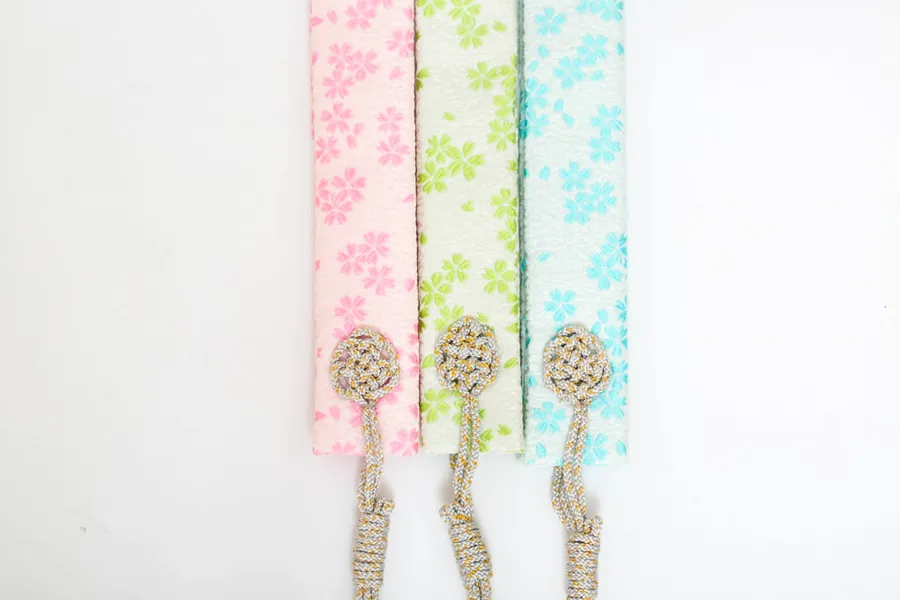
Which small kesa is which?
These are examples of names used for compact kesa. Designs and rules of use vary by school and temple.
| Name | What it is | Where it appears |
|---|---|---|
| 輪袈裟 Wagesa | A ring-shaped, simplified kesa worn around the neck, treated as a sign that the wearer is Buddhist and worn at services. Some are made folded and washable. Full wagesa guide. | Several schools, for lay followers and in some cases clergy; made to each school’s specification. |
| 式章 Shikishō | A narrow strip hung from the neck, carried with prayer beads (nenju) on temple visits. Shikishō and hangesa compared. | Worn by lay members of Jōdo Shinshū Hongwanji-ha. |
| 略肩衣 Ryaku-kataginu | The corresponding narrow neck-worn item in Shinshū Ōtani-ha. | The term used in Shinshū Ōtani-ha. |
| 半袈裟 Hangesa | A narrow neck-worn kesa. Our shop can make hangesa to the specification of schools including Jōdo, Shingon and Sōtō. | Several schools. |
| 絡子 Rakusu | A small kesa hung from the neck, used in Zen traditions. | Zen traditions; who wears it, and when, follows the teacher’s and temple’s rules. |
| 折五条 Ori-gojō | A five-strip kesa folded compactly and worn around the neck, with a cord (fusahimo) whose colour is chosen to match. | Made for schools such as Shingon and Jōdo. |
| 畳袈裟 Tatami-gesa | A kesa made to fold up in an accordion pattern, in the same family as the ori-gojō and wagesa. | Several schools. |
Rules differ by school, temple and role, and we do not want to simplify what is a matter of faith. If you are not sure which one your tradition expects, ask your teacher or temple, and tell us your school and temple so that we can confirm before you order.
Sumi-gesa (墨袈裟) are black kesa, made in silk (gauze, habutae, figured damask, shiose) or synthetic fabric. The form required for ordination (tokudo) or training depends on the school.
What sizes do they come in?
A neck-worn strip is typically about 5 cm wide for adults, about 6 cm in a wider cut and about 4 cm for children. Smaller sizes are also used for a child’s first temple visit (初参式).
Can a small kesa be washed?
Most are silk and are not washed at home. We have, however, developed a wagesa that can be washed in a home washing machine in a protective net: a folded ryaku-tatami-gesa made of a gauze cloth over a gold brocade, available in four colours. Ask us if you need a washable version for hot climates, where a neck-worn kesa picks up sweat quickly. There is also a washable shikishō; see our care instructions.
Which one do you need?
Tell us your school, whether it is for a priest, a lay follower or a child, and your country. We will recommend an item and tell you the price in yen.
Browse on our shop: wagesa, tatami-gesa and ori-gojō · hangesa and shikishō
Frequently asked questions
What is a wagesa?
A wagesa is a ring-shaped, simplified kesa worn around the neck. In several Japanese schools it is the common form of kesa for lay Buddhists, worn as a sign of being a Buddhist; the details depend on the school.
What is the difference between a shikishō and a hangesa?
They are similar narrow neck-worn strips. “Shikishō” is the term for the item worn by lay members of Jōdo Shinshū Hongwanji-ha; “hangesa” is the name used by other schools, and Shinshū Ōtani-ha uses “ryaku-kataginu”. Please confirm with your temple.
Which kesa does a Zen follower wear?
In Zen traditions a small kesa called a rakusu is used. Who wears it, and when, follows the rules of the teacher and temple, so please ask them. For ordination or training, a black kesa (sumi-gesa) may be used, depending on the school.
Can I order a children’s size?
Yes. Neck-worn strips can be made small for children, for example for a child’s first temple visit.
Keep reading

Written by Kengo Kawakatsu (“Naoshichi”), fourth-generation owner of Naoshichi Houiten, a Kyoto maker of kesa and Buddhist robes since 1920.