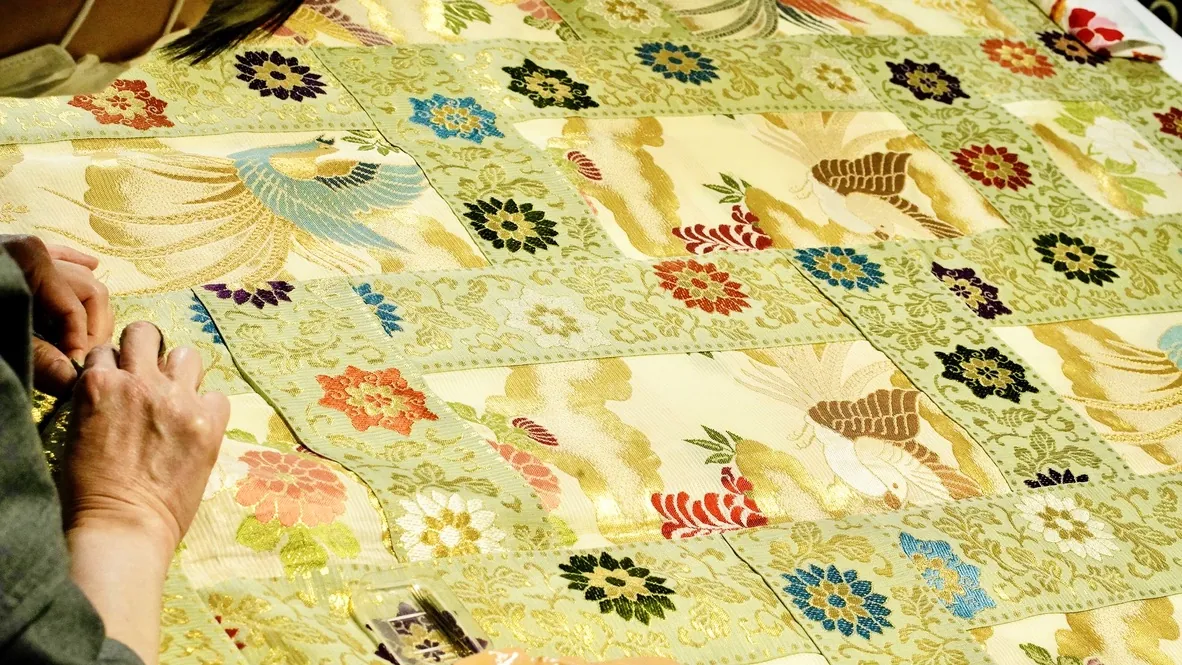
In traditional accounts the three robes (三衣, sanne) are a lower robe (安陀会, andae), an upper robe (鬱多羅僧, uttarasō) and an additional outer robe (僧伽梨, sōgyari, also 大衣). East Asian traditions associate them with the five-strip, seven-strip and nine-strip or larger kesa. How they are used in present-day Japan varies by school and occasion.
What are the “three robes”?
In early Buddhism a monk’s clothing was not a wardrobe but a set of three. They have been called 三衣 (sanne, “three robes”) ever since. A traditional saying holds that even a practitioner of the highest standard is content with these three robes alone.
Mahākāśyapa (摩訶迦葉) is celebrated in Buddhist traditions for his ascetic discipline, which included contentment with the three robes. The number and classification of the ascetic practices (頭陀行, dhūta; commonly counted as twelve) vary by textual tradition. In Zen lineage accounts he is regarded as the first Indian patriarch after the Buddha.
How do the three robes compare?
| Japanese name | Sanskrit | Strips | Traditional role |
|---|---|---|---|
| 安陀会 andae = gojō kesa (五条袈裟) | antarvāsa | 5 | The lower robe. In early accounts it is the most basic robe, used for daily work and rest, and counted almost as underclothing. |
| 鬱多羅僧 uttarasō = shichijō kesa (七条袈裟) | uttarāsaṅga | 7 | The upper robe, associated with practice, worship, meals and lectures. In Japan it is an important ceremonial kesa in several schools. |
| 僧伽梨 sōgyari = daie (大衣) | saṃghāṭī | 9 to 25 | The additional outer robe, for great ceremonies, teaching and formal visits. Traditionally associated with entering a king’s palace. |
How did the three robes come about?
A well-known legend explains it. On a very cold winter night the Buddha spent the early evening wearing only the five-strip robe. As the night deepened and the cold grew worse, he added the seven-strip robe. Towards dawn, when it was coldest, he added the large robe. He then told his followers that in later ages, when they could not bear the cold, these three robes would be enough.
The five-strip kesa (andae / gojō)
In early accounts the five-strip robe is the basic robe used for everyday tasks and rest. In Japan today the five-strip form is also associated with several small, portable kesa, including the folded ori-gojō and the tatami-gesa (see small kesa). The form your school expects depends on its own rules.
The seven-strip kesa (uttarasō / shichijō)
The seven-strip kesa is associated with worship, meals and lectures, and in Japan it is an important ceremonial kesa in several schools. Its other names include 中衣 (chūe, “middle robe”) and 入衆衣 (nyūshu-e, “robe for entering the assembly”). We describe it in detail on the page about the shichijō kesa.
The large kesa (sōgyari / daie)
The large robe consists of nine to twenty-five panels, always an odd number. The standard classification has nine grades, three each in a lower, middle and upper class. In the conventional scheme, each vertical panel contains two long sections and one short section for nine-, eleven- and thirteen-panel robes; three long and one short for fifteen-, seventeen- and nineteen-panel robes; and four long and one short for twenty-one-, twenty-three- and twenty-five-panel robes. Traditional alternative names include 重複衣 (the “doubled robe”) and 入王宮聚落衣 (the robe for entering a palace or town).
Texts also mention other numbers, such as 250 or 84,000, and the figure in Dōgen’s Kesa Kudoku is interpreted in different ways. Such references should be read in the context of the particular text and its commentaries.
What do the three robes mean?
The robes are also called the “field of merit robe” (福田衣, fukuden-e). The stitched lines are compared to the boundaries of rice paddies, and the idea is that the monk is the field in which others plant good deeds. That is why parts of the pattern are named after fields. The colour, too, was meant to stand apart from the five colours of lay clothing; see what is a kesa.
Which of the three do you need?
The appropriate kesa depends on your school, your role and the occasion. Please confirm your temple’s requirements, and tell us your school and the occasions you will wear it, so we can advise you.
Frequently asked questions
What does “sanne” mean?
Sanne is Japanese for “the three robes”: in the East Asian tradition, the five-strip, seven-strip and nine-strip-or-larger kesa that make up a monk’s traditional set.
What is the difference between the five-strip and seven-strip kesa?
In early accounts the five-strip robe is the basic lower robe for daily work and rest, while the seven-strip robe is the upper robe associated with worship, meals and lectures. The seven-strip has more strips and is treated as more formal.
Why is the number of strips always odd?
Traditionally the strips of a kesa are an odd number: five, seven, nine, eleven, thirteen and so on.
Which kesa does a Japanese priest wear most?
It depends on the school, the wearer’s role and the occasion. The seven-strip kesa (shichijō) is an important ceremonial kesa in several schools, while five-strip forms, in folded or small versions, are used in other settings. Please confirm your temple’s requirements.
Keep reading

Written by Kengo Kawakatsu (“Naoshichi”), fourth-generation owner of Naoshichi Houiten, a Kyoto maker of kesa and Buddhist robes since 1920.